The Experiment: Finding the New
"Eyes closed, we listen to inner music, lost in thought and question" Lu Chi, from Wen Fu

Lately, I’ve been experimenting with my writing - (as in Dr. Frankenstein but using a journal and pencil in place of electrodes and lightning) - and it’s opened doors and closed windows for me. I’ve discovered a great deal in the power of words, but I’ve also found new rivers in myself. And that’s felt good.
I’ve spent the last two years moving into hybrid work - fusing genres, blurring lines - or that’s what I’m telling myself. But, it seems to be working on several levels. There’ve been a few falls from cliffs, of course, but I keep moving.
I’m more open to ideas, less controlled. A statement by Stanley Kunitz - “A poem has secrets that the poet knows nothing of” - has been a map for me. I apply his notion of “secrets” to all the forms of writing I’ve been working in - poetry, essay, cnf, flash.
I also hear words by Flannery O’Connor in this - “I write to discover what I know”. My own writing does reveal layers of self - layers I didn’t know were there, but they were. They’ve always been there. Waiting.
So - we wait - for the writing to appear. And, we never know when that’s going to happen. Of course, I’m meaning the moments of writing that lead to discovery - not the day-to-day writing, in whatever genre … the time set aside or found to allow the drafting to move forward. Writing with no plan, no agenda. Putting words on the page - or screen.
I read a BluSky post by the great poet Carl Phillips - who, instead of busying his afternoon in preparation for a class he was teaching, found himself at his desk writing. Phillips wrote that the poem came to him, spoke to him, and… “I did what the poem told me”. There’s a mantra. His words are a foundation for what the writer should be doing. It’s not just for poets though. Any writer. Writing - both as process and product (finished or draft) - has its own time, its own purpose. The danger is to let that pass. It won’t be back - not that nugget - it’s moved on. No one can stand in the same river twice - Heraclitus believed. It’s not the same river, not the same person. So I wrote:
“You didn’t know you knew, but
you did. This is the curse the poem
brings you, slips
through the window’s glass. No one
sees, but I write. And I write
and I write”
- from “I don’t…” - published in Fallen Leaves (Ballerini Book Press, 2025)
…and the writing goes on…
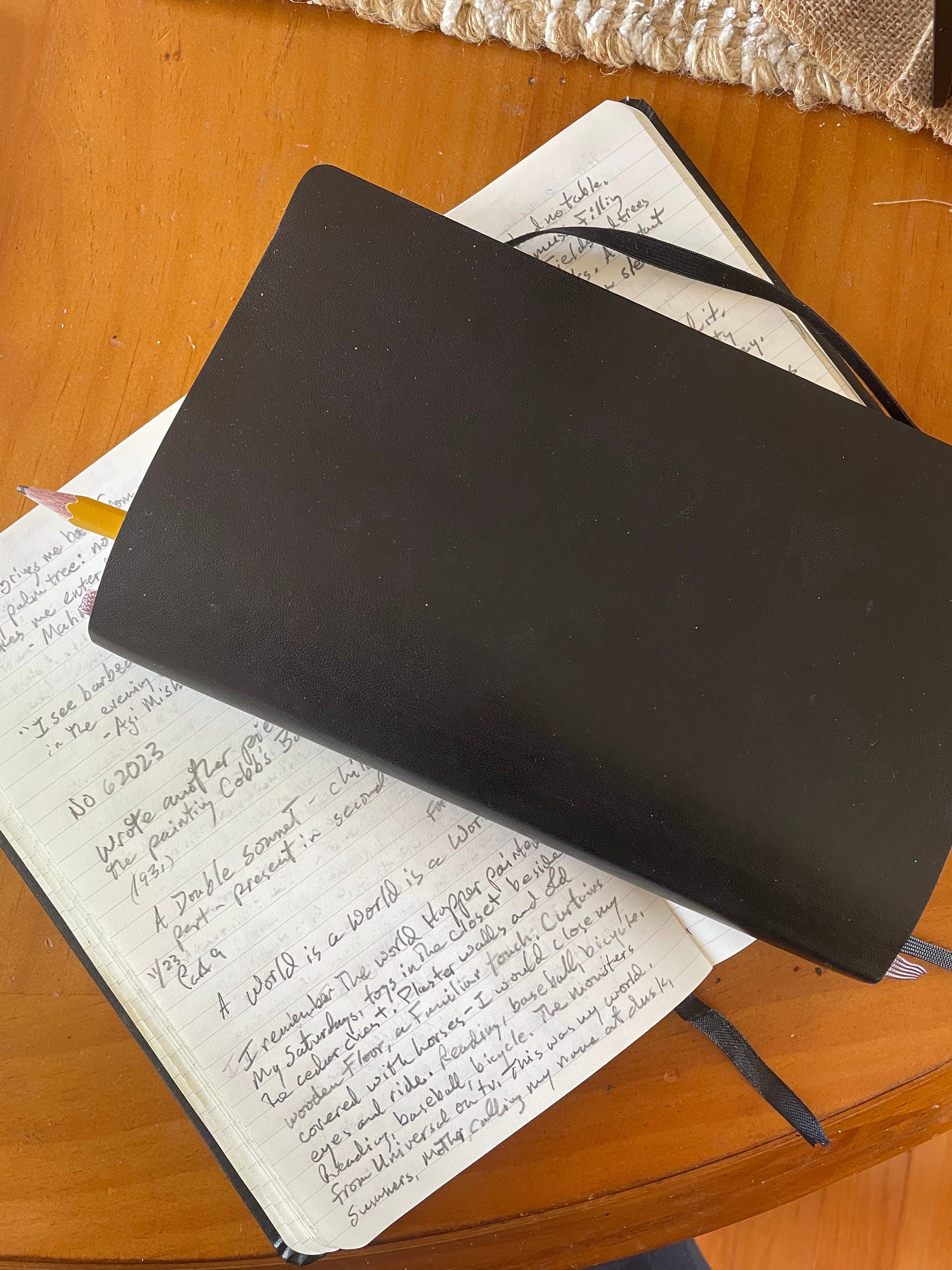
The art is in the listening 🤍
Thank you for sharing, Sam—love this, and good luck with all your writing endeavors, always.